Blog Hosting Pricing in 2026: What Five Hosts Really Cost Over Five Years
Affiliate disclosure: TopTierBlogHost earns a commission when you buy hosting through links on this page. It never changes what you pay, and it never changes which host we recommend. We write up the bad news about our own affiliate partners too.
Every hosting comparison you have read puts the introductory price in a big font and the renewal price in a footnote. That is not an accident, and it is why blog hosting pricing is so hard to compare honestly: the number you shop on and the number you pay are different numbers, on different schedules, for different lengths of time.
This post does the comparison the other way round. Every figure below was checked on the hosts’ own pricing pages on October 9, 2026, and the tables show what each tier costs across its intro term and what it costs every year after that. The headline finding: between the cheapest and the most expensive mainstream shared host, a beginner blogger pays a difference of about $624 over five years for plans that will feel nearly identical in month one.
The five-year number
Start here, because this is the figure that actually decides things and almost nobody publishes it. Each row uses the host’s cheapest advertised path: the longest intro term they offer, then their stated renewal rate.
| Entry plan | Intro rate and term | Paid during intro | Annual cost after | Five-year total |
|---|---|---|---|---|
| Hostinger Premium | $2.99/mo for 48 months | $143.52 | $131.88 | $275.40 |
| Namecheap Stellar | $5.88/mo list, 1-year terms | $55.88 per year | $55.88 | $279.40 |
| Bluehost Starter | $3.99/mo for 36 months | $143.64 | $119.88 | $383.40 |
| SiteGround StartUp | $2.99/mo for 12 months | $35.88 | $215.88 | $899.40 |
| Kinsta Single | $30/mo billed annually | $350 per year | $350.00 | $1,750.00 |
SiteGround and Hostinger advertise the identical headline price of $2.99 a month. Over five years, SiteGround costs 3.3 times as much. The entire difference is term length and renewal rate: Hostinger locks $2.99 for four years and renews at $10.99, while SiteGround locks it for one year and renews at $17.99.
That is not a gotcha about SiteGround. It is a real product difference, and we will get to what the extra money buys. But if you compare on the advertised price alone, you are comparing two numbers that mean completely different things.
Tier by tier, within each host
The second question beginners ask is which tier to take. Blog hosting pricing within a single host follows the same pattern as between hosts: the step up is priced to encourage it, and for a new blog it is almost always unnecessary.
Hostinger
| Plan | Intro (48 months) | Renews at | Step-up cost per year |
|---|---|---|---|
| Premium | $2.99/mo | $10.99/mo | Baseline |
| Unlimited | $3.99/mo | $16.99/mo | +$72.00 |
| Cloud Startup | $7.99/mo | $25.99/mo | +$180.00 |
SiteGround
| Plan | Intro (12 months) | Renews at | Step-up cost per year |
|---|---|---|---|
| StartUp | $2.99/mo | $17.99/mo | Baseline |
| GrowBig | $4.99/mo | $29.99/mo | +$144.00 |
| GoGeek | $7.99/mo | $44.99/mo | +$324.00 |
Bluehost and Namecheap
| Plan | Intro price | Renews at | Notes |
|---|---|---|---|
| Bluehost Starter | $3.99/mo (36 mo) | $9.99/mo | Lowest renewal of the big shared hosts |
| Bluehost Business | $6.99/mo (36 mo) | $13.99/mo | Adds sites and backup features |
| Namecheap Stellar | $55.88 per year | $55.88/yr | 30-day free trial; 2 years for $102.88 |
| Namecheap Stellar Plus | $85.44 per year | $85.44/yr | Unmetered storage, auto-backup |
Bluehost prices exclude VAT and GST where applicable. Namecheap does not label which term its $2.28 promotional figure applies to, so the table uses the explicit yearly totals from its pricing section instead.
What the higher tiers actually buy
Three things, in descending order of how much they matter to a new blog.
More sites. Entry plans at Hostinger and Bluehost are single-site or near it. If you intend to run two or three blogs, the step up is cheaper than two accounts. If you will only ever run one, it is money for nothing.
Backups and staging. SiteGround’s GrowBig adds on-demand backups and a staging copy. These are genuinely useful once you have traffic and a reason to fear breaking things, and genuinely pointless in month one when your blog has four posts and no readers.
Resource allocation. This is the one hosts are vaguest about, and the vagueness is the point. You are buying a larger slice of a shared server. It is real, it is unmeasurable from outside, and it only becomes visible when you outgrow the entry tier — which for most blogs is somewhere north of 25,000 monthly visits.
Our general advice, which costs us affiliate revenue to give: start on the entry tier. Upgrading mid-term is a two-click operation at every host in this table. Downgrading is not.
Where managed hosting fits
Kinsta’s $350 a year looks absurd next to Hostinger’s $131.88, and for a new blog it is. But the comparison is not like for like: Kinsta Single includes daily backups, free malware cleanup, staging, and a CDN, with support staffed by people who work on WordPress specifically. WP Engine’s entry Essential plan sits at a similar level, starting at $28 a month and $336 paid annually.
The threshold we use is this: managed hosting makes sense once the annual price difference is small relative to what the blog earns. The gap between Hostinger Premium and Kinsta Single is $218.12 a year. On a blog earning nothing, that is your hosting budget nearly tripled for features you will not use. On a blog earning $500 a month, it is about 3.6% of revenue for daily backups, free malware cleanup and WordPress-specialist support — which is cheap, and the point at which most people should stop optimizing blog hosting pricing and start optimizing their time. We go deeper on this in our comparison of shared, VPS and managed WordPress hosting.
The costs this table leaves out
Hosting is not the whole bill, and pretending otherwise is how people end up surprised. Budget for:
- Domain renewal, typically $10 to $20 a year after a free or $1 first year. The free-domain-first-year offer is real at Hostinger and Bluehost; the renewal is at list price.
- Email, which is bundled at some hosts and $6 to $7 per mailbox per month elsewhere.
- A premium theme or page builder, if you want one — $50 to $100 one-off or annual.
- Tax, which several hosts exclude from the advertised price.
- A renewal you did not plan for, which is the single most common surprise — see our running tracker of hosting renewal prices in 2026.
Our full breakdown of the realistic first-year total is in how much it costs to start a blog.
Who should NOT buy the cheapest plan
We spend most of this site arguing that beginners overspend on hosting. Here are the cases where the cheap option is genuinely the wrong call.
If you cannot commit for four years. Hostinger’s $275 five-year total depends entirely on paying $143.52 up front for 48 months. On a 12-month term the economics change completely, and a one-year Hostinger plan is not obviously better value than anyone else’s. If you are not sure you will still be blogging in 2028, a 12-month term at a host with a low renewal — Bluehost at $9.99 — is the more honest choice.
If support quality matters more to you than price. This is the thing SiteGround’s renewal premium actually buys, and the reason we still recommend it to people who expect to need help. Paying $899 over five years instead of $275 is a bad deal measured in gigabytes and a reasonable one measured in not being stuck.
If your blog is already your income. At that point you are not buying hosting, you are buying uptime insurance, and the shared tier is the wrong product regardless of who sells it.
For everyone else — and that is most people reading this — the entry tier at Hostinger on the longest term you are comfortable committing to is the lowest-regret purchase in this category. If the four-year commitment is the sticking point, Bluehost Starter renews lower than anyone else here. If you want the support, SiteGround StartUp is the one to pay up for, with eyes open about year two.
Frequently asked questions
Why is hosting so much cheaper in the first year?
Introductory pricing is a customer acquisition cost. Hosts accept a loss or thin margin on the first term because the majority of customers renew at full price rather than migrate. The renewal rate is the real price of the product.
Which blog hosting tier should a beginner pick?
The entry tier, almost always. Upgrading later takes two clicks and no downtime at every host listed here, and the resources on an entry plan comfortably handle a blog up to roughly 25,000 monthly visits.
Is a four-year hosting term a good idea?
It is the cheapest option and the least flexible one. It makes sense if you are confident about the host and the project. If either is uncertain, take 12 months and accept a higher rate — the difference is around $5 a month, which is cheap optionality.
Can I negotiate a renewal price?
Sometimes. Contacting support before an auto-renewal and asking for a retention offer works more often than people expect, particularly at the larger hosts. It costs one support ticket to find out.
Does cheaper hosting mean worse uptime?
Not reliably at this end of the market. All five hosts here advertise 99.9% uptime and broadly deliver it. The differences that correlate with price are support response time, backup frequency and performance under traffic spikes — not raw availability.
Will these prices go up in 2027?
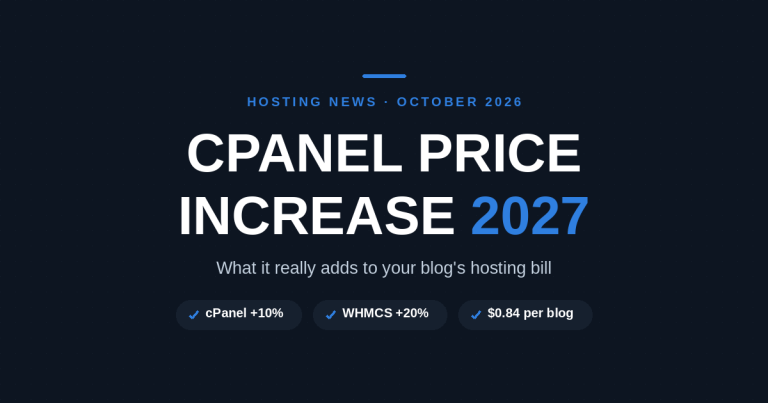
Probably, modestly. Control panel vendors are raising licence costs between 8% and 20% from December 2026 and January 2027, though that works out to under a dollar per site per year. Renewal pricing changes far more than licensing does.
The bottom line
Blog hosting pricing rewards one habit above all others: compare renewal rates and term lengths, not headline prices. Two hosts advertising $2.99 a month can differ by $624 over five years, and the difference is invisible on the pricing page you are shopping from.
For a new blog, the entry tier is the right tier, the longest term you are genuinely comfortable with is the cheapest path, and the step up to a higher plan is a decision to make when traffic forces it rather than when the pricing table suggests it.
And write your renewal date in your calendar the day you sign up. Nearly every bad hosting-cost story we hear starts with someone discovering the renewal rate after it was charged. If you want the plan-by-plan recommendations behind these numbers, they are in our guide to the best web hosting for bloggers.
Sources
- Hostinger — Web hosting pricing (checked October 9, 2026)
- SiteGround — Web hosting pricing (checked October 9, 2026)
- Bluehost — Shared hosting pricing (checked October 9, 2026)
- Namecheap — Shared hosting pricing (checked October 9, 2026)
- Kinsta — Managed WordPress plans (checked October 9, 2026)
- WP Engine — Plans and pricing (checked October 9, 2026)